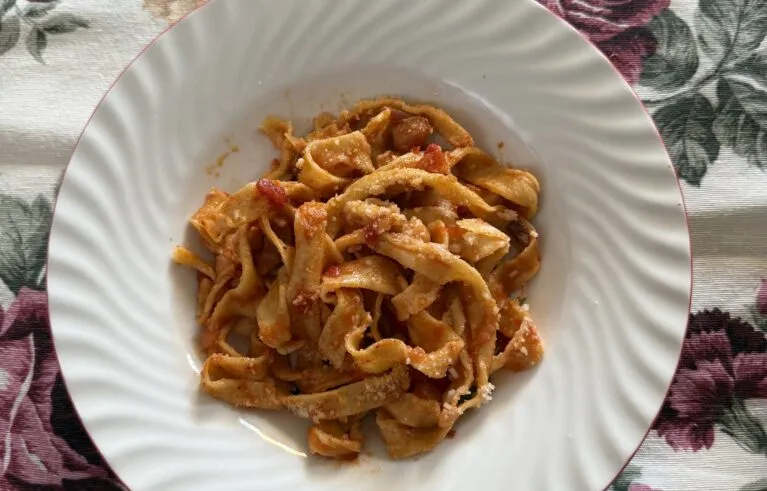
In this written series, we find out the personal histories behind some of London’s favourite Italian delicatessens.
Masha Rener, the head chef at one of London’s most famous delicatessens and restaurants, Lina Stores, dials in to our conversation between stroking local cows and importing furniture to her rustic house in Umbria’s countryside. I ask her how she’s settling in: “it’s very different from London,” she says.
It’s not long before the B word comes up. Brexit, that is. Masha is the third deli owner I’ve spoken to who is directly impacted by regulatory changes and has made the decision to move back home. Despite heading back to her rural roots, she is still very much plugged into the business, popping back and forth to the UK’s capital on the regular. “There isn’t really a schedule like I used to have before it was about once a month for 10 days or so. Now? Well, it just depends.” Her travels aren’t just limited to London; Lina Stores now has 11 UK sites including Manchester, and international franchises in Tokyo, Japan. It’s evident Lina Stores is no stranger to upholding authentic values in the face of change while allowing for expansion. I chat to Masha about their long-standing ability to ‘keep it real’.
Lina Stores started in the war-scarred spring of 1944 when a woman called Lina Parisio, born in a small village near Genoa, walked out of northern Italy with two siblings and crossed borders on foot, carrying the recipes she had grown up with and her instinct for survival. She arrived in Soho at a time when “olive oil was only sold at the pharmacy in those days,” Masha tells me. “It was considered medicine.”
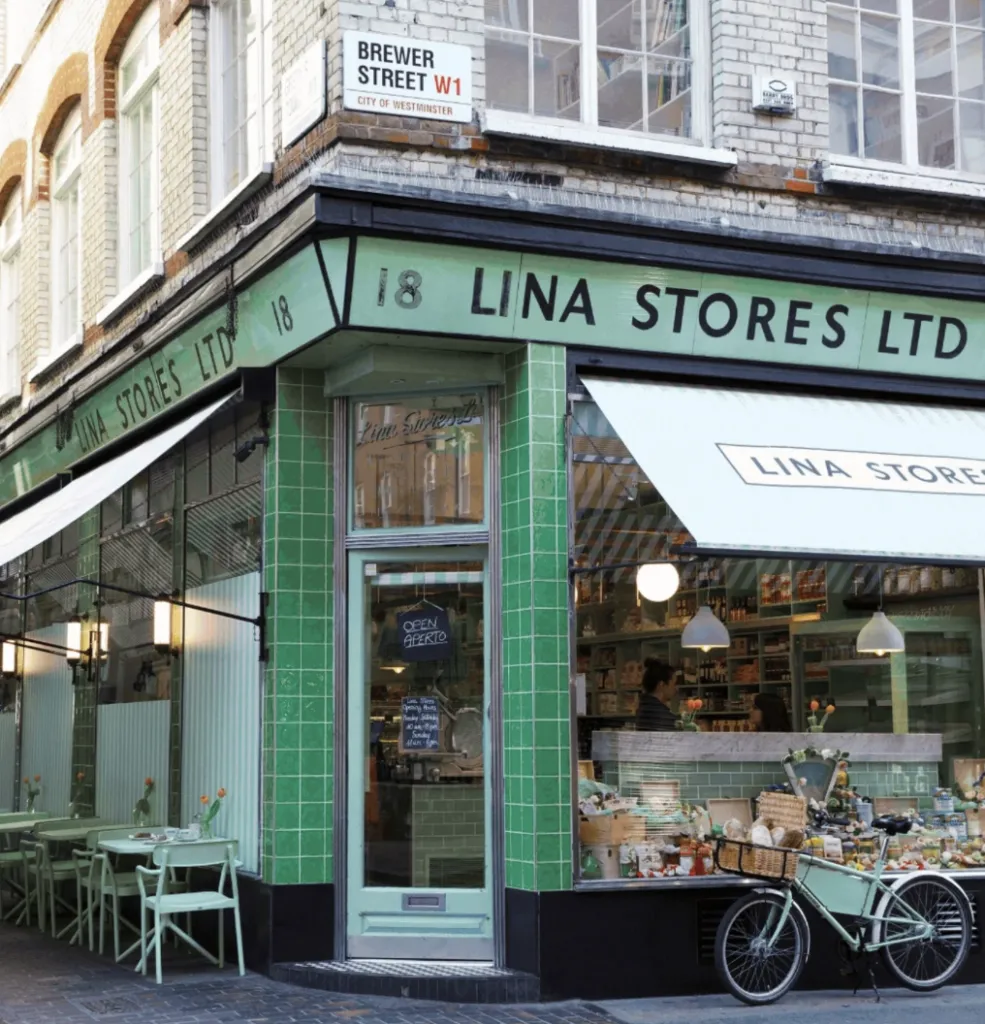
Before opening the deli, Lina worked at the Italian Hospital in Queen’s Square, where she met Enrico Emilio Crippa, who went on to become her partner, both in business and life. Emilio ran a small produce business and employed two trusted Italian colleagues, and together they started selling parmesan, cured meats and fresh pasta to a post-war London. When they found the empty shop at 18 Brewer Street, they took the leap and opened Lina Stores. The name? Well, that’s got a funny story behind it too. It owes its identity to a clerical typo: “it was meant to be “Lina’s Store,” but the apostrophe was never placed,” shares Masha. From the beginning of the establishment, Lina was at the forefront. Her energy became part of the wonder of the deli windows and she was seen making fresh pasta by hand through the glass. Lina wasn’t the only star of the show. There was a furry friend rumoured to carry trays of pasta around the streets of Soho. When no delivery vehicles were available, Lina and Emilio strapped trays of pasta to their large dog’s back and walked through Soho to deliver to restaurants so that no Soho locals, Italian families missing home, or actors, musicians and cultural figures passing through Theatreland went hungry.
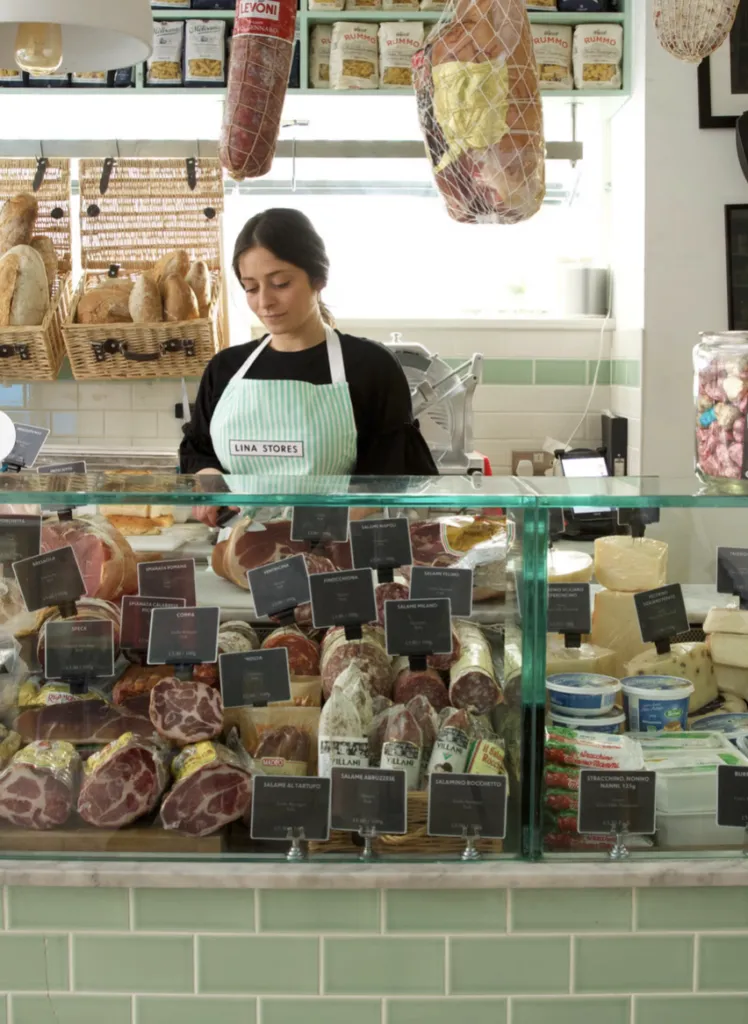
When Emilio died in 1967, he left everything to Lina, and she retired back to Italy. The Seradi family, who had been working with them from the start, carried the business on in her absence. Then, in 1978, the Filippi family took over and continued the traditions Lina had set down, down to each supplier and identical pasta machine. Hearing about the story from Masha, it’s clear this is a place built on many carefully considered pasta-baton passes.
So how did Masha get involved? “I grew up in a restaurant kitchen, my mum was a chef. Actually, before she became a chef, she was a model. She’s a really good-looking woman and worked in Milan for many years.” After some time living a cosmopolitan existence, her parents decided to leave the city for a more sustainable life in the countryside. “They started this small business in ’85. I didn’t have any relatives here, no grandmother, no grannies, no auntie, no uncle, zero, nothing. I just grew up with my mum in the kitchen. It was like a different era.” It was in her childhood that Masha learned the pasta techniques which form the foundation of Lina Stores’ restaurants. “I was able to do the pasta with the rolling pin and tagliatelle in a traditional way.” Yet it wasn’t just the pasta process that excited her: “I did also a lot of like experiments.” Her creations were influenced by seasonal produce: “I used to have new and fresh ingredients every day. I changed the menu every day in our family restaurant, based on what was available in the garden and between the animals on the farm. This made me very curious about the cuisine; to mix the influence from around the world and led me to research all Italian cuisine, not just the Umbrian one.” That’s very much the ethos of Masha and her team: they’re not bound by tradition; modern modifications are encouraged. Masha’s favourite place to innovate is with ravioli, tortelli and agnolotti: “Yeah, I love filled pasta. I love to play with the fillings a lot. And I work a lot with vegetables. I dry [them] in the oven, to create a kind of a dust so I can colour pasta. You can do this with the beetroots, peanuts, turmeric.”
After high school in 1999, Masha moved to London. “Here, I was desperate to find good Italian products, so I started to go to the deli on Brewer Street. The manager at the time was a girl called Marina. This is how we met and then we became really good friends.” Masha moved back to run her family business in the countryside in 2001, where she spent much of her life on a farm and running a tiny restaurant. She recalls being on the phone to Marina: “and it was really kind of a joke in the beginning.” The two of them chatted until the joke percolated into reality, and at the same time Masha’s family business was closing. “We started the first restaurant in 2018. And we worked on the project for about a year first. It was a little bit tricky for us to find a good site in Soho. We wanted to find something close to the deli because when we started, we were cooking in the deli’s basement.” The transfer of spaghetti and ravioli was no longer done via a tray-balancing canine creature, but by bike. Between the restaurant on Greek Street and the deli on Brewer Street is around half a mile. It’s a 10-minute walk but a two-minute cycle. Maybe three, if you’re making sure you don’t split any edges on your tortellini. Masha found working with Italians on an Italian project in London comforting: “I knew London because I had lived there so somehow it was my second home, but also it was very, very far away from what I was doing in Umbria.”
What was it that made it feel so welcoming? The people. “I think Lina we did such great business because we are a really good team. We still are the same people from day one; we work super well together. Most of our head chefs in the restaurant are Italians. They know about Italian traditions.” And when rolling out new locations, they’re highly considered. At the first two sites, they kept everything in one kitchen and distributed food from there to ensure quality. “We produced everything in one big kitchen and deliver prepared food to the restaurants, to keep the consistency.” Now with many more sites dotted over the city, there’s technology at play so that each recipe is identical (Masha regularly taste-tests when she visits to make sure). “We have a super easy Excel programme that we use to keep the recipe at the standard, always.”
Fancy upholding the standard yourself? They offer pasta boxes and kits to make meals at home. This lucrative add-on was born out of the pandemic but has continued thanks to demand. And it’s not something Masha happily jumped into, though: “I’m very against the pasta takeaway. It’s something that cannot really work,” she says. The kits are comprised of fresh pasta and other ingredients you assemble yourself. “It’s done to push people to make it better. It’s also helping people to better understand Italian philosophy in cuisine.”
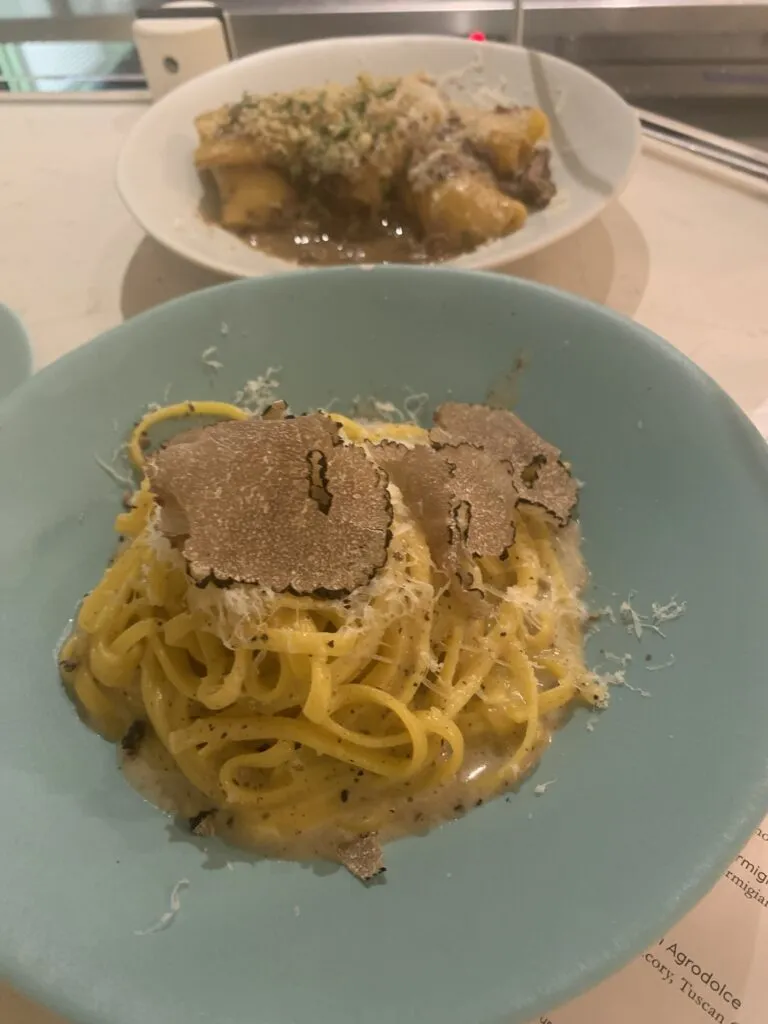
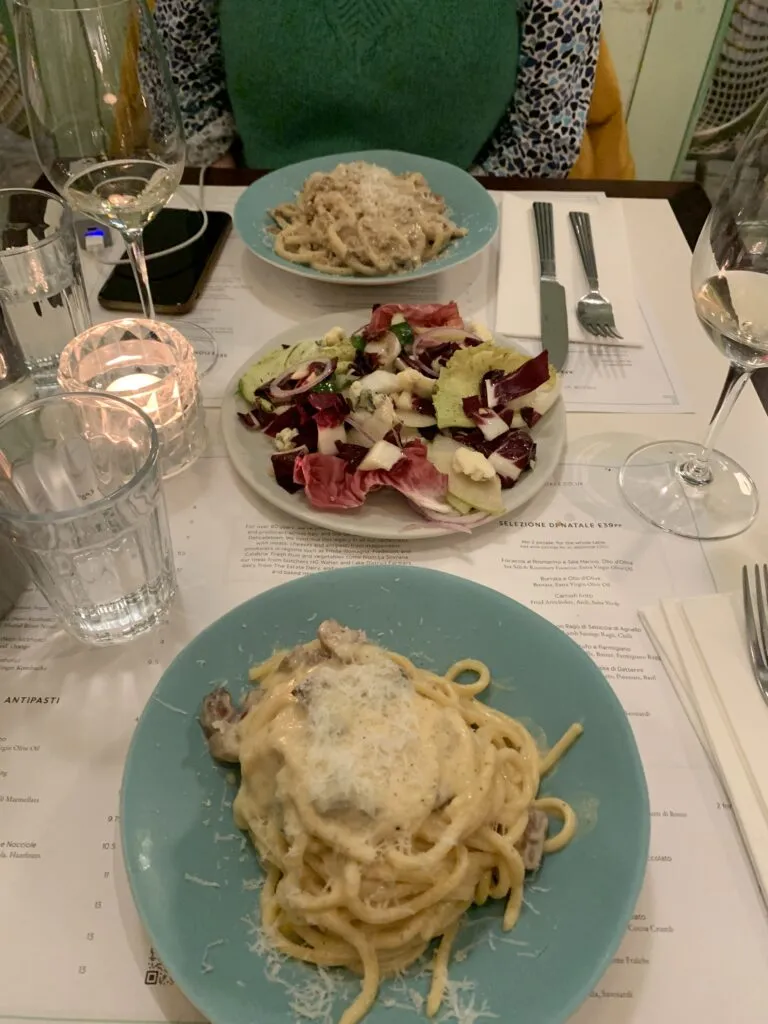
Of course, this place is the people and the pasta, yet so many great Italian delis with those two ingredients never reach this level of expansion. I wonder what has led this place to amass nearly one million followers and be regularly cited on multiple publications’ ‘best pasta’ list? Of course, the pasta is stand-out but that goes without saying. “And don’t leave without trying the truffle tagliolini,” Masha emphasises. The real reason? My marketing brain has a hunch the virality could be linked to how they’ve positioned themselves as a designer handbag of pasta restaurants.
It’s a beautiful spot, whichever location you visit. Shiny chrome, candy-stripe features, with exquisite turquoise-green ceramics. Masha lets me in on a little secret about their signature branding: “So if you’ve been to the Brewer Street deli, you’ll notice there, for example, there are around 20 different greens. In the past 80 years, we were trying to keep the same green.” Colours discontinue and fade; near-matches became colour-wash palettes, and when it came to designing the colour scheme for the restaurants, it was more challenging than it might look. “It was very difficult to find our Pantone colour and decide which was ‘the perfect one.’” Eventually, they settled on Pantone’s ‘Tiffany’ — in case you’re hoping to recreate their stylish tablescape in your own kitchen.
We finish our chat by asking her to describe Lina Stores in three words. “Passionate, definitely. Authentic.” Both words come out without a second of hesitation. There’s a wave of joy in her eyes as she says the next sentence: “I will say…‘full of life’.” She goes on to talk fondly of the team, listing waiters, managers and chefs. “I think Lina Stores is a real lesson…how to be like a contemporary Italian place without compromising on the sort of traditional authentic family.” She’s got Croatian in her blood too, but she believes Italians have the best hospitality on the planet. “If you end your night in an Italian bar, you will become friends with someone. You maybe will be invited for dinner,” she laughs before promising me: “If I come into Lina Stores and you’re there, I will not leave until 3 am and we will drink Campari.” She’s firm on that — that sounds like a promise I’m very willing to stick to.
Visit the original Brewer Street deli at: 18 Brewer Street, W1F 0SG.
Do you have a favourite deli you’d like us to visit? Let us know. If you liked this, there’s more Behind the Counter content on the Pasta Grannies website. Or, if you fancy going further afield why not see other notes from our travels on our blog.